
How To
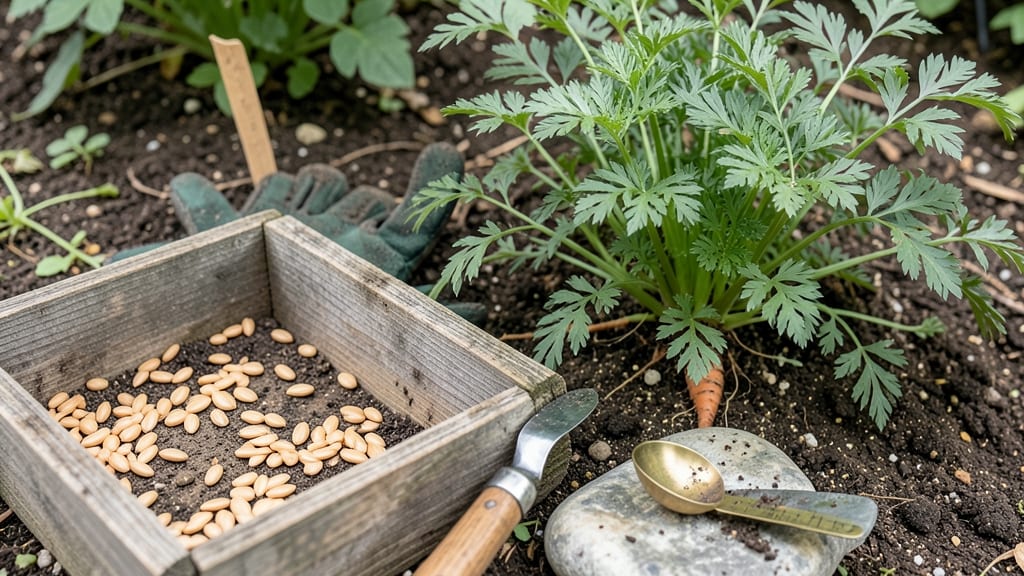
To plant carrots in a 50' x 30" bed with perfect spacing, you’ll need just 1.5–2 grams of seed—about the weight of a paperclip—when sown at 1–2 inches apart.
Planting carrots in a 50' x 30" bed can feel overwhelming—too little seed means sparse harvests, while too much leads to overcrowding and stunted roots. But with the right seed-to-space ratio, you’ll achieve uniform, restaurant-quality 🥕 every time.
Most gardeners overshoot by 50% because they assume tiny seeds need bulk. In reality, a single gram covers 10 linear feet when spaced correctly, so a 50-foot row only needs 5 grams total—no more.
Below, I’ll break down the exact grams per foot, how to adjust for row vs. broadcast planting, and pro tips to avoid thinning nightmares. Let’s get those straight, sweet roots growing!


Exact carrot seed amount for 50' x 30" bed: grams per linear foot
Calculating the perfect amount of carrot seed for your 50' x 30" bed ensures you avoid both sparse harvests and overcrowded roots. Most seed packets list quantities for 10-foot rows, but scaling up requires precision—especially since carrot varieties vary in size and spacing needs.
For example, 'Paris Market' (short roots) needs less seed than 'Danvers Half Long' (long roots).
Start with 0.5–1 gram of seed per linear foot for most varieties, but adjust based on your soil type. Loose, sandy soil allows closer spacing (1 inch apart), while heavy clay may require 2 inches apart to prevent forking.
Always account for germination rates, which average 70–85%—so buy slightly extra to compensate for uneven sprouting.
For your 50' x 30" bed, multiply the grams per foot by 50 to get the total seed weight. For example, if you’re planting 'Danvers Half Long' at 0.6g per foot, you’ll need 30 grams total.
Always weigh your seed on a kitchen scale—most packets include a gram guide on the back.
Uneven germination is common with carrots, so sow seeds in two successive plantings spaced 2 weeks apart. This ensures a continuous harvest rather than a single flush. If your soil is rocky or compacted, increase spacing to 2.5–3 inches and reduce seed slightly to 0.4–0.5g per foot.
After sowing, cover seeds lightly with soil (no deeper than 1/4 inch) and keep the bed consistently moist until sprouts appear. Avoid overwatering, which can cause seeds to rot before germinating. A fine mist spray or drip irrigation works best for even moisture distribution.
Once seedlings reach 2–3 inches tall, it’s time to thin them. Use sharp scissors to snip unwanted plants at soil level—this prevents disturbing roots of neighboring carrots.
Aim for 2–3 inches between mature plants, adjusting based on your variety. For 'Paris Market', you can space them as close as 1.5 inches.
If you’re planting in rows (not broadcast sowing), space rows 12–18 inches apart to allow for weeding and airflow. For broadcast sowing (scattering seeds evenly), reduce the seed amount by 10–15% since competition will be higher. Always mark
How to space carrot seeds for maximum yield: step-by-step guide
Proper seed spacing is the secret to growing straight, plump carrots instead of forked, stunted ones. For a 50' x 30" bed, spacing seeds 1-2 inches apart in rows 12-18 inches apart gives roots room to develop without competing.
Uneven spacing or overcrowding leads to forked roots or poor yields, so let’s break this down step-by-step.
Start by calculating your seed quantity based on spacing. A 1-inch spacing requires about 0.5 grams of seed per linear foot, while 2-inch spacing uses 0.25 grams per foot.
For a 50-foot row, that’s roughly 25-50 grams total, depending on your chosen spacing. Always buy a little extra—germination rates vary, and you’ll need spares for uneven sowing.
Step-by-Step Guide to Perfect Carrot Spacing
Loosen soil to 12 inches deep with a fork to prevent forking. Mix in compost for loose, nutrient-rich soil. Avoid clumps—carrots need even, fine soil.
Use a string and stakes or garden bed frame to mark rows 12-18 inches apart. For a 30" bed, two rows work perfectly. Keep rows straight for easy thinning later.
Plant seeds 1/4 inch deep using a seed drill or spacing wheel for precision. Space seeds 1-2 inches apart—closer for baby carrots, wider for mature varieties. Aim for 0.5 grams per linear foot for 1-inch spacing.
When seedlings are 2 inches tall, thin to 2-3 inches apart for mature carrots. Use scissors or a knife to snip unwanted plants at soil level—avoid pulling to prevent disturbing roots.
For even spacing, try seed tapes or a spacing wheel. These tools save time and ensure seeds are planted at the correct depth and distance, reducing the need for thinning.
Avoid these common mistakes: planting seeds too deep (they won’t sprout), skipping soil prep (leads to forking), or overcrowding (stunts growth). If your soil is rocky or clay-heavy, opt for shorter varieties like 'Paris Market' and space them 1 inch apart to prevent issues.
After thinning, mulch rows with straw or grass clippings to retain moisture and suppress weeds. Water gently to avoid disturbing seedlings—aim for 1 inch of water per week. With these steps, you’ll harvest uniform, sweet carrots in 70-80 days! 🥕